The next tech cycle could look nothing like the last. The AI boom won’t follow the dot-com playbook, AI is changing the innovation model - and markets know it.
Investors should prepare to watch for shifts where value is created, and where power, utility markets and hard assets become beneficiaries.
For decades, investors understood the technology growth model. Public research funding laid the foundations for breakthrough innovation. Venture capital financed high-risk entrepreneurs.
Expanding middle-class consumption created mass demand for new products and services. Talent moved freely between universities, established firms and startups, accelerating the pace of commercialisation.
That combination helped build the modern technology sector - from semiconductors and personal computing to the internet economy. It also created many of the world’s most valuable companies. Today, a new technology cycle is underway. But this time, the model may be very di?erent.
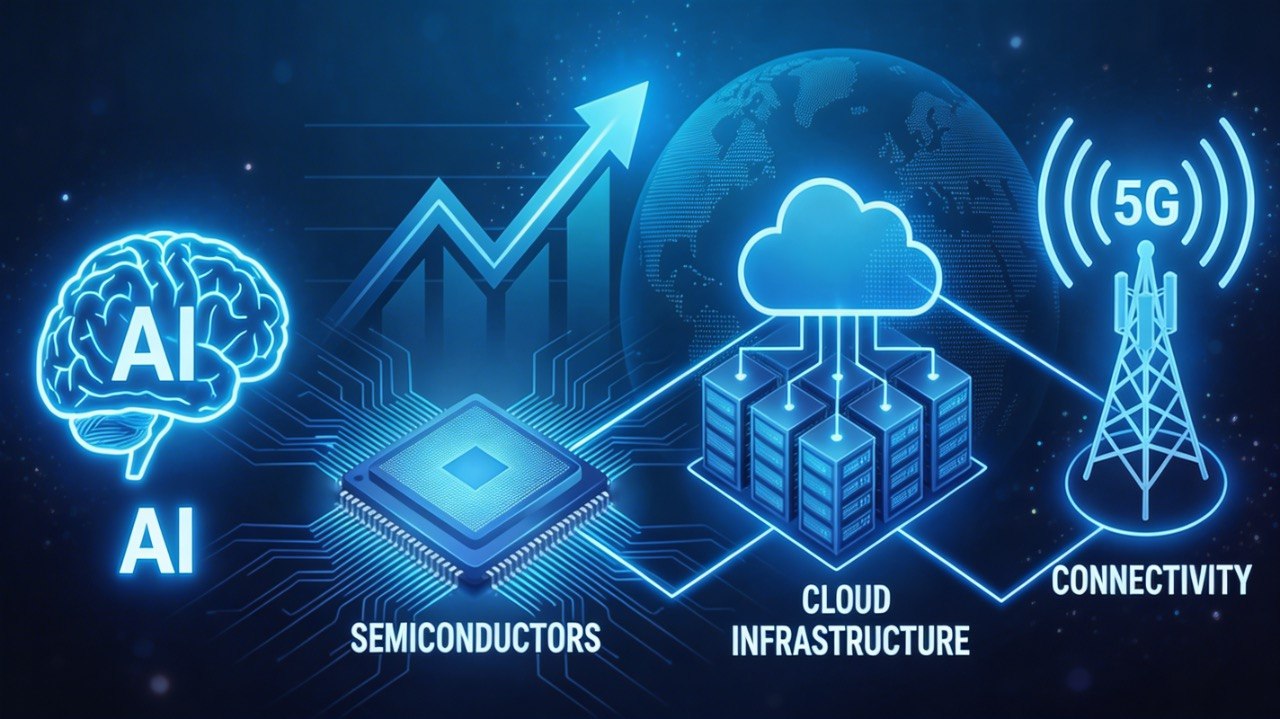
Artificial intelligence, advanced semiconductors, cloud infrastructure and next-generation connectivity are shaping what could become the next major wave of productivity and economic growth. Yet unlike previous cycles, the current phase appears more capital intensive, more strategically contested and more dependent on physical infrastructure.
For investors, that distinction matters.
Innovation Is Becoming Infrastructure-Led
Earlier technology booms were often driven by software scalability. Once built, successful platforms could expand globally with relatively low marginal costs. The AI cycle changes that equation.
Building and deploying frontier AI systems requires enormous investment in data centres, advanced chips, power generation, cooling systems, networking capacity and specialised talent. These are not light-asset dynamics. They resemble infrastructure cycles as much as software cycles.
This may help explain why capital expenditure is increasingly concentrated among a small group of global firms with the balance sheets to fund it.
For markets, this could broaden the opportunity set beyond traditional software winners into sectors linked to enabling infrastructure, including semiconductors, industrials, utilities, logistics and digital real assets.
Policy Is Back at the Centre of Markets
Technology is also becoming more strategic. Governments are taking a more active role in sectors such as artificial intelligence, semiconductor manufacturing and advanced supply chains through subsidies, regulation, procurement and industrial policy.
This marks an important shift. For much of the last globalisation era, markets often assumed technology would scale across borders with relatively few constraints. Today, export controls, localisation requirements and national security considerations are becoming more influential.
For investors, policy may become an increasingly important driver of valuation, competitiveness and geographic capital allocation.
The Geography of Innovation Is Expanding
The traditional centres of innovation remain powerful. Silicon Valley, major US research hubs and leading Asian manufacturing clusters are likely to remain critical. However, the next phase may be more geographically distributed.Regions with access to low-cost energy, strategic capital, modern infrastructure and strong connectivity may play a larger role in enabling future growth. This could create opportunities outside the traditional technology centres.
The Gulf is one region worth watching. Its growing role in global energy markets, sovereign investment capacity and strategic position between Asia, Europe and Africa may support participation in emerging technology ecosystems, particularly where energy, data infrastructure and logistics intersect.
The next technology cycle may not reward the same exposures that defined the last one. While software innovation remains important, value creation may increasingly shift toward the assets and systems that enable computation at scale. That suggests investors may need to think more broadly about where the beneficiaries of AI-led growth emerge.
- Advanced semiconductors and hardware ecosystems
- Power generation and grid infrastructure
- Data centres and digital connectivity
- Industrial automation and advanced manufacturing
- Regions attracting strategic capital and policy support
The last great technology era was built on code, connectivity and consumer scale. The next one may well be built on compute, energy and strategic capital. If so, investors who rely solely on the old playbook may miss where the next wave of opportunity is being created.