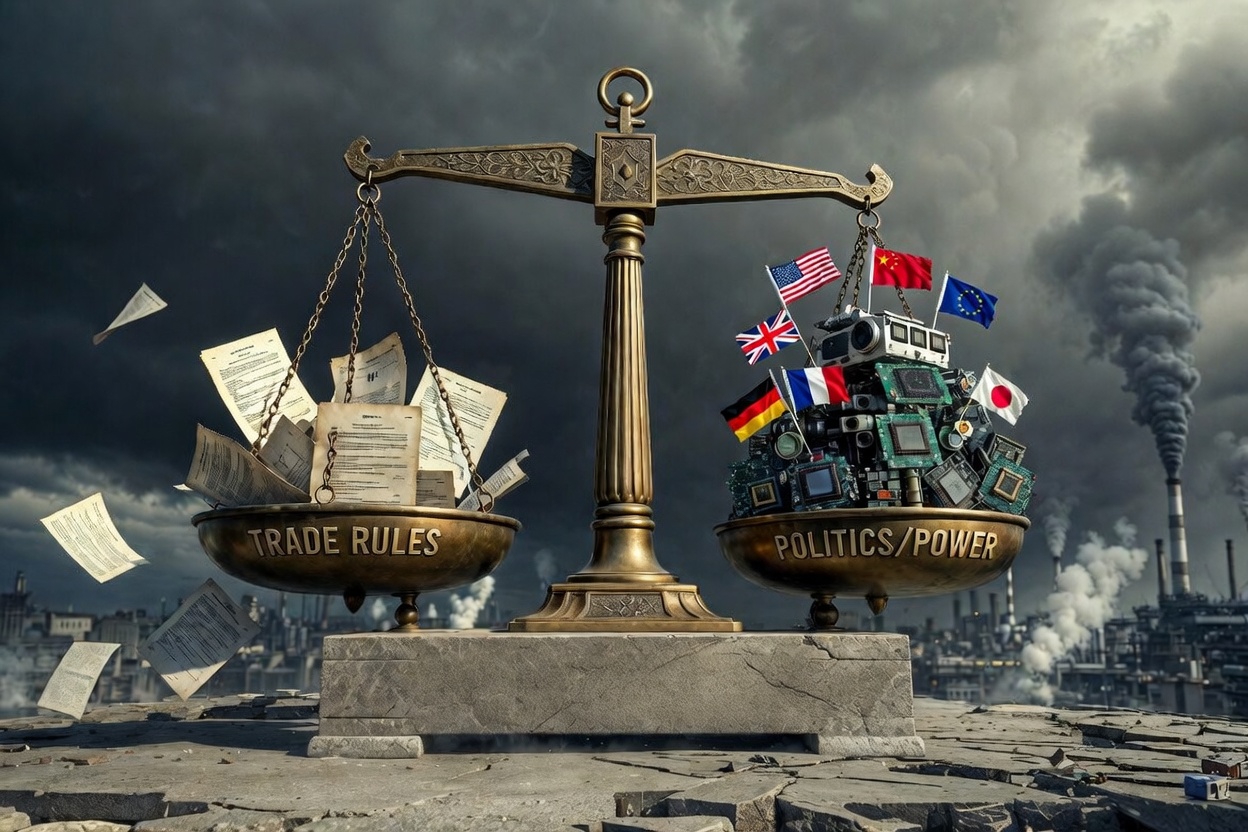
The global trading system is entering a phase of structural uncertainty. Rising protectionism, geopolitical fragmentation, and the growing overlap between trade and security policies are reshaping the foundations of international economic governance. At the center of this transition lies the World Trade Organization (WTO), increasingly under pressure both externally and internally.
The upcoming WTO Ministerial Conference (MC14) in Yaoundé comes at a critical moment, not because it is expected to deliver sweeping agreements, but because it will define the trajectory of global trade governance in an era where fragmentation is no longer a risk, but a reality.
From a geoeconomic perspective, three interconnected dynamics stand out:
The weakening of multilateral enforcement frameworks.
The paralysis of the WTO’s Appellate Body has weakened the credibility of the rules-based system. For investors, this translates into rising uncertainty around dispute resolution and enforcement. Trade rules still exist, but their predictability, long considered a cornerstone of global markets, is increasingly contested.
The return of industrial policy as a strategic tool.
Major economies are actively reshaping supply chains through subsidies, tariffs, and regulatory frameworks. The United States, the European Union, and China are deploying industrial strategies targeting semiconductors, clean energy, and critical technologies. This shift marks a departure from efficiency-driven globalization toward resilience-driven regionalization.
For capital allocators, this trend is both political and structural. Investment flows are increasingly aligned with policy frameworks rather than purely market signals. Strategic sectors are becoming policy-defined ecosystems, where access, incentives, and regulatory alignment determine competitive advantage.
The fragmentation of trade rules across parallel systems.
The proliferation of regional trade agreements and unilateral measures, from carbon border taxes to digital trade frameworks, is creating a layered and uneven regulatory landscape. Rather than a single global system, businesses now operate within overlapping regimes, each with its own standards and compliance requirements.
This fragmentation has direct implications for investment strategies. It increases transaction costs, complicates cross-border operations, and reinforces the importance of geopolitical risk assessment in portfolio construction.
Yet, despite these pressures, the WTO remains highly relevant. A significant share of global trade continues to operate under its framework, and membership remains near universal. The issue is not whether the WTO will disappear, but how it will evolve. This is where MC14 becomes strategically important.
Market participants should focus on signals:
- Will there be progress on dispute settlement reform?
- Can members converge on a framework for integrating sustainability into trade without creating new barriers?
- Will developing economies secure greater policy space within the system?
The answers to these questions will shape the next phase of global economic integration.
This structural transition signifies markets moving toward a model where policy, technology, and capital are increasingly intertwined. In this environment, traditional macro indicators are no longer sufficient to anticipate risk and opportunity.
The key is the ability to decode policy-driven market shifts in real time by identifying sectors aligned with industrial policy incentives, anticipating regulatory fragmentation across jurisdictions, and mapping how geopolitical alignments reshape supply chains.
In practical terms, this favors data-driven, AI-enabled investment approaches capable of integrating geopolitical signals into financial decision-making. As global trade becomes more complex and less predictable, information asymmetry widens, and with it, the opportunity for those equipped to navigate it.
In this new landscape, the competitive edge will not come from reacting to markets, but from anticipating the architecture shaping them.